Real Money Casino App iPhone: The Licence Behind the Icon
 Available in GB
A real money casino app for iPhone is a downloadable client for a gambling site that holds a Gambling Commission licence, with staking and payouts in cash. Apps from operators without a British licence sit outside GamStop entirely. Those apps build in no UK protection, and a self-exclusion set with GamStop Online holds for its full term.

For years the honest answer about iPhone casino apps was that there weren’t any, at least not in the App Store. Apple’s rules on real-money gambling software have always been tighter than anything the Gambling Commission wrote, and for a long stretch the only way an iPhone owner could reach a casino was through Safari with a saved bookmark that looked faintly like a shortcut. That has changed, cautiously. British-licensed operators now ship genuine iOS apps for slots, live dealer tables and betting, and they behave like any other regulated product: identity checks before the first spin, hard limits on bonus terms, and a self-exclusion scheme that actually reaches the account.
The awkward part is what sits alongside them. Plenty of offshore apps describe themselves as casino apps for iPhone with real-money payouts, are installed through a configuration profile or a web app on the home screen, hold a licence from Curaçao or Anjouan, and are not connected to GamStop. I have watched this niche for years and the pattern rarely changes: the sharper the welcome offer, the thinner the regulation behind it. So this page is about the licence, the checks and the exclusion term — the things that decide whether the app on the home screen is worth the storage.
Where the licence hides on an iPhone
On a phone everything is compressed, and that includes the paperwork. A desktop casino puts its licence number in small type in the footer, where anyone can find it in three seconds. An app puts it wherever the developer felt like it — an “About” tab, an “i” button inside the cashier, sometimes only in the browser version of the same site.
The Gambling Commission’s position is blunt: it is illegal to offer commercial gambling services to consumers in Great Britain without a Commission licence, and that includes an operator holding a licence somewhere else. Section 33 of the Gambling Act 2005 carries a maximum of 51 weeks’ imprisonment on summary conviction, or a fine at level 5, for the operator. The offence is the operator’s, not the player’s — that distinction matters and it is the one people get wrong.
GamStop is the other half of the same equation. The scheme is the UK’s national online self-exclusion service, run by The National Online Self Exclusion Scheme Limited, free of charge. It has been available to consumers since April 2018 and went live on 27 April 2018. One detail worth knowing, because it costs people searches: the scheme’s name is frequently typed as “gamestop”, and it is GamStop on every official page. Members of the public in Great Britain set exclusions of six months, one year, five years, or five years with auto-renewal, and the block applies across every online operator licensed in Great Britain.
The standard for British licensed apps
The British-licensed app is the benchmark, and it is a demanding one. Since 31 March 2020 participation in GamStop has been a condition of holding an operating licence, the requirement sitting in the Commission’s Licence Conditions and Codes of Practice at social responsibility code provision 3.5.5, which says licensees must participate in the national multi-operator self-exclusion scheme. Since April 2020 operators have had to check their whole customer base against the register at least every 24 hours. Identity verification happens before a customer is allowed to gamble, under licence condition 17.
What that buys an app user is not excitement. It is a set of constraints on the operator: a maximum wagering requirement of ten times on bonus funds since 19 January 2026, a ban on promotions that mix betting, casino, bingo and lottery products, the prompt to set a financial limit before the first deposit, retention of identity data at the point of registration, and a customer account that has to be closed and its balance returned if the person is on the register.
Casino apps iPhone real money without a British licence
Offshore apps hold licences from other jurisdictions, and those jurisdictions are not all the same. Curaçao rewrote its regime under the National Ordinance on Games of Chance, which took effect on 24 December 2024 and made the Curaçao Gaming Authority the direct licensing and supervisory authority. Provisional licences issued by operation of law were due to expire on 24 June 2025 and were extended once, to 24 December 2025. Anjouan issues Internet Gaming Licences under legislation adopted in 2005, with a published issuance fee of EUR 17,828. Kahnawà:ke has regulated interactive gaming since 1999 and requires its operators to be hosted in the Mohawk Territory.
None of that connects an app to GamStop. GamStop Online can only exclude from participating operators, and the Commission’s own terms say it is unable to prevent access to gambling services run by organisations that do not participate in the scheme. That is why offshore apps are advertised in places where self-exclusion comes up: the exclusion does not follow you there. I want to be plain about the moral arithmetic of that. An operator that markets to people who have asked to be left alone is not offering freedom; it is selling the absence of a safeguard, and the price is paid later.
There is enforcement, though less of it than the loud versions suggest. Since April 2024 the Commission’s Illegal Markets team had issued 3,140 cease and desist and disruption notices by the October 2025 count, referred 447,778 Bing and Google URLs, and secured 287,961 removals. Across 160 illegal websites with traffic data there was an average 32 per cent fall in engagement after action, with registrar blocks producing a 91 per cent average drop. A cousin of that work: the Commission issued an industry warning notice on 20 January 2025 about games from licensed operators turning up on unlicensed sites available to GB consumers, noting that such sites often target people who have self-excluded through GamStop. The Commission is a regulator and not an ombudsman. It cannot get anyone’s money back.
Comparing apps by their safety features
Brands are useless as a sorting principle and I refuse to use them. What sorts these apps is method: how the money moves, how the account is verified, and what happens when the person wants to stop. Everything below is a criterion, not a company.
| Criterion | British-licensed app | Offshore app with a foreign licence | App with no licence at all |
|---|---|---|---|
| Where the licence sits | Gambling Commission operating licence; number and domain on the public register | Curaçao, Anjouan or Kahnawà:ke licence; CGA seals redirect to cert.cga.cw | Nothing verifiable — Costa Rica has no comprehensive gambling licensing regime |
| Identity check timing | Before the customer is permitted to gamble, under licence condition 17 | Often only at the first withdrawal | Usually at withdrawal, if it comes at all |
| Bonus terms | Wagering requirement capped at ten times since 19 January 2026; no mixed-product promotions | Commonly 25× to 60×, with maximum cashout clauses attached | Anything the developer writes, revised without notice |
| Reverse withdrawal | Banned permanently since 31 October 2021 | Frequently available | Frequently available |
| Withdrawal speed evidence | Commission data for June to September 2024: 96.3 per cent of 44.2 million withdrawals cleared automatically | Not reported to any regulator in Great Britain | Not reported anywhere |
| Self-exclusion reach | GamStop Online blocks the account | No GamStop linkage | No GamStop linkage |
| Complaints route | Free ADR after eight weeks, via a Commission-approved provider | Anjouan names EGIS ADR, Axion ADR, iGaming ADR and a listed ADR provider; enforcement is remote | Effectively none |
Why the identity check is the most important step
This is the single thing the whole topic turns on, and it is the bit nobody reads before installing. An iPhone app makes the verification feel like a formality — Face ID, a fingerprint, done. The check that matters is the operator’s, not Apple’s.
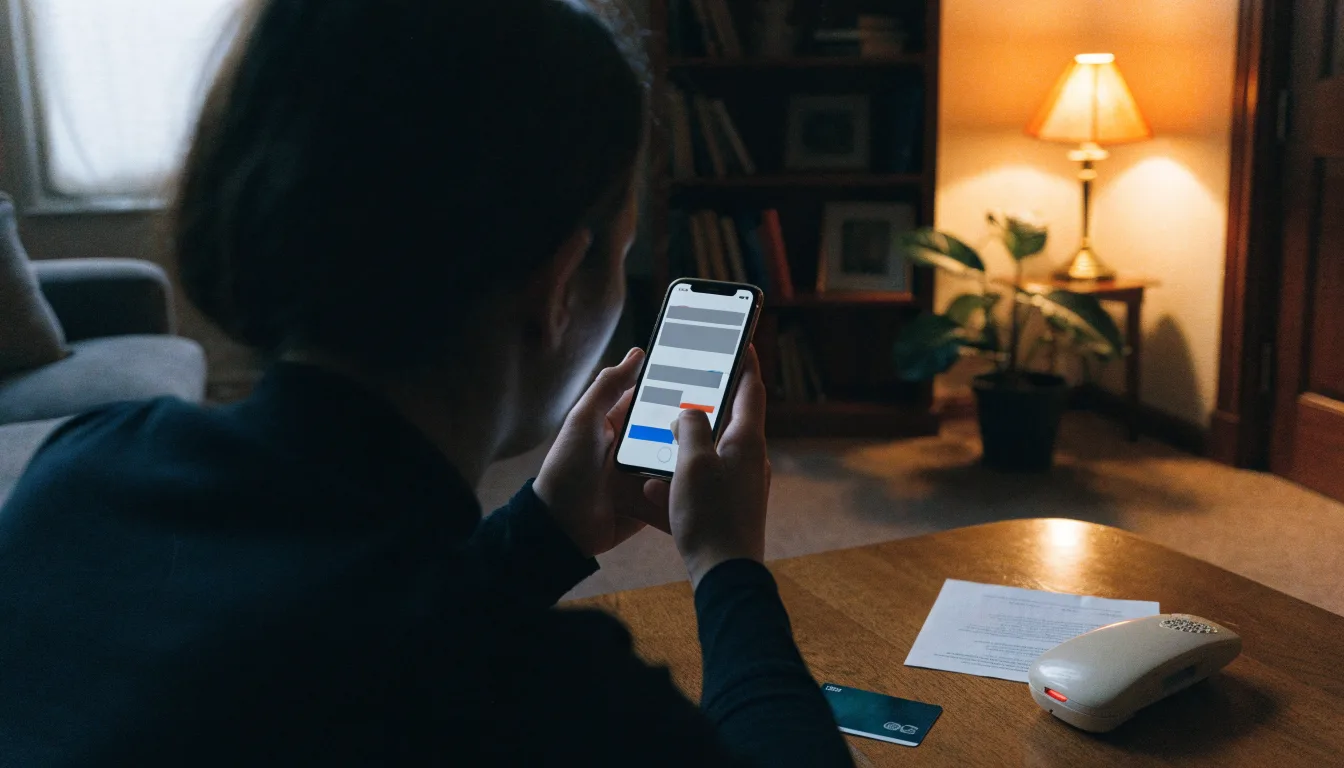
The first time, a British-licensed app asks for name, address and date of birth, and verifies them before the person is allowed to gamble. It may do that electronically by matching the account against databases such as credit reference agencies and the electoral roll, in which case nothing further is needed and the whole thing is invisible. If it cannot, it will ask for a passport, a driving licence or a household bill. The Commission does not specify which documents a business should request, and it states it cannot give a timescale because the length of the process varies. What it has said, in an August 2026 blog, is that onboarding on incomplete or inaccurate information — initials instead of full names, nicknames, commercial addresses instead of residential ones — is not sufficient, and it has flagged concern about operators relying on “fuzzy matching” through third-party verification providers.
Later, the check does something different. It reappears when the stakes get large. Anti-money-laundering rules in the Money Laundering, Terrorist Financing and Transfer of Funds (Information on the Payer) Regulations 2017 require identification and verification in remote casinos once a customer deposits or withdraws €2,000 or more, counting linked transactions and, in a remote casino, transactions forming part of the customer’s overall activity during a single logged-on period. Then there is licence condition 17.1.1: a withdrawal request must not result in a requirement for additional information if the licensee could reasonably have requested that information earlier. That prohibition does not override a genuine anti-money-laundering obligation.
The warning signs on an iPhone app
- Documents demanded only at withdrawal. This is the classic. Over a quarter of complaints reaching the Commission’s Contact Centre concern identity verification, and the annual report for 2024-25 records that withdrawal issues remain the cause of most complaints received. Where a business delays a withdrawal because of insufficient ID it may be in breach of licence condition 17.
- The account is not blocked after a self-exclusion. On a British-licensed app it must be, and the balance must be returned.
- The terms reserve discretion to void winnings. Language giving an operator the sole right to close accounts or forfeit winnings is unfair within the meaning of the Consumer Rights Act 2015. One operator was fined £170,000 in July 2025 over a term of just that shape.
- A maximum withdrawal limit on the deposit balance. A term such as “You may withdraw up to £50 per day” is prohibited for UK-licensed operators.
- No cooling-off, or a cooling-off with no clock. British licence conditions do not leave the review period vague; a scheme that can switch protection on and off within a day is not protection.
Five signs an iPhone casino app can be trusted
It holds a current Gambling Commission licence
The Commission advises consumers to check that the business holds a British licence and to click through to the public register to see whether the site’s activities and domain names match. On a phone, open the site in Safari, find the licence number in the footer or the About screen, then check it against the register. A licence number that appears nowhere, or a licence from another jurisdiction presented as if it were British, is the answer to the question.
The licence seal resolves to the right domain
Foreign regulators now publish verification tools, and they are specific. Clicking a Curaçao Gaming Authority Certificate of Operation Seal must redirect to cert.cga.cw; if the seal differs in design, colour or format the site is not authorised by the CGA. If the certificate behind the seal shows a different domain name from the one being accessed, the site is displaying another operator’s certificate and should be treated as unauthorised or fraudulent. A historic /JAZ number or legacy seal is not independent proof of a current Curaçao licence, because the legacy orange sub-licence certificates of operation ended on 15 October 2025.
Identity checks happen before the first spin, not at cash-out
Licence condition 17 requires the operator to obtain and verify information establishing identity before the customer is permitted to gamble. The Commission’s expectation, restated in August 2026, is that identity and age checks are brought forward to before a customer deposits or stakes. An app that lets money go down the screen for three weeks and then asks for a utility bill has told you the order of its priorities.
The money arrives, and the route is documented
Withdrawal complaints are the Commission’s single largest category, and its stated position is that it is not acceptable for operators to introduce friction when a customer tries to withdraw rather than when they deposit. Look for a stated processing time in the app’s own help pages, a named complaints procedure with an eight-week clock, and a named alternative dispute resolution provider. If the app’s terms do not link a complaints route at all, the operator has not finished building the product.
Customer funds are rated and the rating is disclosed
Licence conditions 4.1.1 and 4.2.1 require remote operators holding customer funds to keep them separate from business accounts, to select one of three ratings — “not protected”, “medium protection” or “high protection” — and to state in writing which applies, with the customer acknowledging receipt on the first deposit. An operator rated “not protected” must remind the customer every six months. A separate client account is not a guarantee of return on insolvency; gambling businesses may hold customer money in overseas bank accounts.
How to judge an iPhone casino app in six steps
- Check the licence against the Commission’s public register before installing anything. Do it in the phone’s browser, not in the app, so the register is not competing with the operator’s own design. The domain names listed on the register must match the domain the app connects to.
- Read the bonus terms before opting in, and convert them into cash. A ten-times wagering requirement on a £100 bonus means £1,000 of play before any of it is withdrawable, and each game contributes differently — slots usually in full, table games often at 20 per cent or less. If the app does not state the contribution rates, assume the worst ones apply.
- Set a financial limit at the deposit prompt, then leave it alone. Since 31 October 2025 all gambling businesses must prompt customers to set a financial limit before the first deposit, and the prompt must present setting one as the default, with a positive action needed to decline. That is a genuinely good rule and it is worth using properly rather than tapping through.
- Install blocking software as a second layer and check whether it costs anything. GamStop signposts Gamban and BetBlocker. Gamban blocks licensed and unlicensed sites, and its free UK licence scheme, TalkBanStop, ended on 31 March 2026; it is now free for residents of Wales, and £4.99 a month or £29.99 a year in England and Scotland after a seven-day trial.
- Ask the bank to block gambling transactions at card level. Commission-listed banks offering the service include Bank of Scotland, Barclays, Halifax, HSBC, Lloyds Bank, MBNA, Monzo, NatWest, Royal Bank of Scotland, Santander and Starling. Blocks work on gambling merchant category codes and must be activated on each card, and most banks then apply a 48-hour or 72-hour cooling-off period before gambling transactions are allowed again.
- Keep the report routes where you can find them. The National Gambling Helpline, run by GamCare, is free on 0808 8020 133, 24 hours a day, every day of the year, and the same number reaches live chat and WhatsApp. Callers in Wales are given 0808 2819 265. It is not a crisis line; staff cannot transfer people at immediate risk and follow their own safeguarding procedures instead. Gamblers Anonymous England, Wales & Ulster can be reached on 0330 094 0322.
How self-exclusion works, and how long it lasts
The brief for this site is the exclusion term, so let us be exact. A person registers with GamStop Online, which takes only a few minutes, and the block can take up to 24 hours to become effective. The term chosen is six months, one year, five years, or five years with auto-renewal. Once registered, a person cannot cancel or deactivate during the exclusion period, and the exclusion stays in place after the end of the chosen period unless they contact GamStop to remove it. Registrations cannot be removed early; the Group’s 2025 annual report devotes a section to its refusal to remove registrations before the chosen term ends.

The auto-renewal option has its own arithmetic. Under the terms of use, the auto-renewal option may only be turned off during the last six months of a five-year minimum exclusion period, and auto-renewal continues for up to four new five-year periods. If the person does not deactivate after their chosen period, GamStop holds the data through a further automatic seven-year self-exclusion period during which operators are told they were previously excluded. That is the bit people miss: an unremoved exclusion is not a lapsed one.
The numbers show how many people are sitting inside that arrangement. GamStop recorded 117,756 new registrations during 2025, with 561,983 active exclusions at the end of the year. In the first half of 2026 registrations rose 16 per cent year on year, May 2026 setting a monthly record of 12,236 sign-ups, and as of July 2026 the register carried 614,738 consumers, of whom more than one in two had opted for the maximum five-year exclusion while only one in four had self-excluded for six months. Under-25s accounted for nearly one in three of all exclusions in that half-year, a 26 per cent year-on-year increase. Land-based schemes tell a different story: the Commission’s May 2026 FOI response put SENSE at 12,445 active self-excluded customers and Gamstop Betting Shops, formerly MOSES, at 9,075.
Offshore smartphone apps sit outside all of it. They are neither obliged nor able to check the register. Kahnawà:ke runs its own voluntary self-exclusion, which it describes as permanent and irrevocable, and a player who breaches it forfeits deposited or won funds to a charity chosen by the Commission; Anjouan requires licensees to name an approved dispute-resolution provider and expects complaints to be resolved within 30 days. Those are real provisions. They are also not the same protection, adjudicated by a British regulator, with a free route to dispute resolution after eight weeks.
What the market numbers say about iPhone casino apps
iPhone owners have not been handed a separate gambling market. The Great Britain gambling industry’s gross gambling yield was £17.5 billion in the year April 2025 to March 2026, up 4.4 per cent. Remote casino, betting and bingo generated £8.3 billion of that, up 6.9 per cent, against £4.9 billion from the land-based sectors. Online gross gambling yield for January to March 2026 alone was £1.55 billion, up 7 per cent year on year, on 26.8 billion bets and spins.
Illegal sites are a thin slice of a very large cake. The Commission’s analysis published 5 November 2026 estimates that 0.6 per cent of respondents across the whole population, including non-gamblers, engaged with illegal gambling websites in the past four weeks; among those who had gambled online in the past four weeks the figure is 2.5 per cent, plus 1.5 per cent in the past 12 months. Its dashboard recorded 586 illegal gambling websites accessible to GB consumers in September 2026, and 311 faced disruption in the second quarter of 2026-27. H2 Gambling Capital, a market-intelligence firm, puts stakes with illegal operators at £16.6 billion in 2025, up from about £5 billion in 2019. The estimates differ by an order of magnitude depending on who is asked and what they are counting.
One more number, and it is the one worth remembering when an operator markets itself as the friend of the self-excluded. Of the exclusion periods selected by registrants in 2025, 29 per cent chose six months, 24 per cent chose one year, 25 per cent chose five years and 22 per cent chose auto-renewal.
Answers to common questions about real money apps
What is the best real money casino app for iPhone in 2026?
There is no single best, and any list that names one is selling something. Sort by what can be verified: a current Gambling Commission operating licence matching the domain the app connects to, identity verification before the first gamble under licence condition 17, a bonus with wagering capped at ten times since 19 January 2026, a documented complaints route with a free ADR provider after eight weeks, and a customer-funds protection rating disclosed in writing. An app that satisfies those five is doing what a regulated product should.
Are there real money casino apps on the Apple App Store for UK players?
Yes, from British-licensed operators, and the reviews and age rating make them easy to spot. The commercial condition to watch is the licence, not the store. An app can be perfectly legitimate and still not be licensed by the Gambling Commission, in which case it carries none of the UK protections: no GamStop check, no ten-times wagering cap, no eight-week complaints clock, no requirement to return the balance of a self-excluded account.
How does self-exclusion work on an iPhone casino app?
A person registers with GamStop Online, which takes a few minutes, and the block can take up to 24 hours to take effect. Operators must check their whole customer base against the register at least every 24 hours under the requirement introduced in April 2020. When a match is found, the licence conditions require the customer account to be closed and any funds in it returned. It is not sufficient merely to stop the individual withdrawing while still accepting wagers.
How long does a GamStop exclusion last?
The terms offered are six months, one year, five years, or five years with auto-renewal. It cannot be cancelled during the exclusion period, and it stays in place after the chosen period ends until the person contacts GamStop to remove it. Registrations cannot be removed early. Auto-renewal may only be switched off in the last six months of a five-year term, and if nothing is done the data is held through a further automatic seven-year period.
Do offshore casino apps work around a self-exclusion?
They are not connected to GamStop, so the block simply does not reach them. That is a fact about the scheme’s design, not a loophole to be used: GamStop Online can only exclude from participating operators and cannot prevent access to services run by organisations that do not participate. The Commission issued an industry warning notice in January 2025 noting that unlicensed sites often target self-excluded customers and may have inadequate social responsibility and anti-money-laundering controls.
Why does a casino app ask for documents before I can withdraw?
Two different rules are in play. Anti-money-laundering regulations require identification and verification in remote casinos at €2,000 or more in deposits or withdrawals, counting linked transactions. Separately, licence condition 17.1.1 says a withdrawal request must not trigger a request for information the licensee could reasonably have asked for earlier. If the documents could plainly have been requested at registration, the delay may be a breach of licence condition 17 — and over a quarter of the Commission’s Contact Centre complaints concern exactly this.
The Licence, the Check and the Term
An iPhone casino app is only as good as the licence behind it, the identity check it runs before taking a stake, and the exclusion term it is obliged to honour — and only one of those three is visible from the home screen.
GamStop had 614,738 consumers on its register as of July 2026, and more than one in two of them chose the maximum five-year exclusion.
Casino Apps – Play Current UK
Content created by the «Play Current UK» team